Although the role-playing game is an intrinsic part of entertainment culture, it hasn’t been with us for very long. The earliest role-playing games evolved in the late 1960s and peaked with Gary Gygax and the invention ofDungeons & Dragonsin the early 1970s. The following decade saw an explosion of table-top RPG games at about the same time video game versions also started to appear.
RELATED:The Best Multiplayer RPGs Of All Time
Some of the best TTRPGs came out during the 1980s, and although not many had the same impact asD&D, which has always dominated the market, they were still great games. They had unique combat and character creation systems, and many of them were popular enough to last through the years and have remakes, sequels, or modern equivalents.
8Call Of Cthulhu (1981)
It’s a bit of trivia thatD&Dis based on the literary works of J.R.R. Tolkien, so why nota game based on HP Lovecraftfor horror fans? This TTRPG is more closely based on the book of the same name and is highly customizable, so although it’s mostly horror it can be used with other gaming systems or works inspired by other authors.
Call of Cthulhuuses Basic Role-Playing rules that were developed in the late 1970s with a game calledRuneScape. Levels and hit points are not a factor, but the player gains more competence the more they use their skills.

7Das Schwarze Auge (1984)
The literal translation of this title in English is “The Black Eye” which doesn’t have the same connotation in German. That’s why this was localized asThe Dark Eyewhen it came stateside. It was more popular thanD&Din Germany for a whileand had a high-fantasy themewith a simple class and level system.
RELATED:Best New RPGs Coming Out In 2023
The first edition of this game was translated into Dutch, French, and Italian but never into English. It wasn’t until the second edition was released in 1988 that English-speaking gamers got to experience the morbid gaze ofThe Dark Eye.
6Powers & Perils (1983)
One of the earliest examples ofan incredibly complicated and detailedgaming system,Powers & Perilswas intended for more dedicated gamers. Even the first edition included the extensive resources needed to organize and play a campaign, which includes no less than five rulebooks, one of which is also an introductory adventure.
The game was a financial failure for publisher Avalon Hill, which is why few other materials were produced before the title was permanently discontinued.It was well received by players and criticsbut the release was badly timed and it was buried under the popularity ofD&D.

5Star Wars: The Roleplaying Game (1987)
Of course, there was aStar Wars-themed role-playing game from the 1980s.The publisher, West End Games, also made a TTRPG out of theGhostbustersmovie and used the same basic gaming system for this adaptation.
RELATED:RPGs That Have Unique Classes
The legacy ofStar Wars: The Roleplaying Gamegoes well beyond the classic TTRPG, which was popular enough to prompt a second edition in 1992 and a 30th Anniversary edition in 2018. The reference books are still source material for the extensiveStar Warscanon and there are books, video games, and comics based on those resources.
4Warhammer (1983)
It’s hard to believethatWarhammerwas first releasedin the 1980s, but it’s been a cornerstone of the TTRPG world for 30 years. There hasn’t been a new edition since 2015, but Games Workshop has announced a new project to resurrect the game,Warhammer: The Old World. It’s been in development since 2019 but no firm release date has been announced yet.
Not all TTRPGs use miniatures or maps, butWarhammerfamously does, and to a detailed extent. The game has inspired several derivatives that use the same aesthetic and rules, such asWarhammer 40,000andWarmaster.

3Classic BattleTech (1984)
A science fiction spin on a medium that often uses fantasy as the main theme,BattleTechwas always popular and still enjoys a strong following. The franchise still exists, and there have been new versions, editions, and resources in steady supply up to the present day.
RELATED:RPG Characters That Start Really Weak But Eventually Become Very Powerful

The battles are played on elaborate hexagonal boards with a variety of miniatures to represent each player’s mechanical minions. The combat units, called BattleMechs, come in a variety of designs and give the game its distinctive look.
2Top Secret (1980)
It was the time of the Cold War, and the espionage aesthetic was popular in all kinds of media. TSR, the company that producedD&D,also publishedTop Secret. The gameplay relied on the use of 10-sided dice and used percentiles to measure skills and attributes.
Instead of a class system, a character works for one of three bureaus within an unnamed intelligence agency: Assassination, Confiscation, or Investigation. This is similar to the earliest version ofD&Dthat only had the Thief, Fighter, and Mage classes.

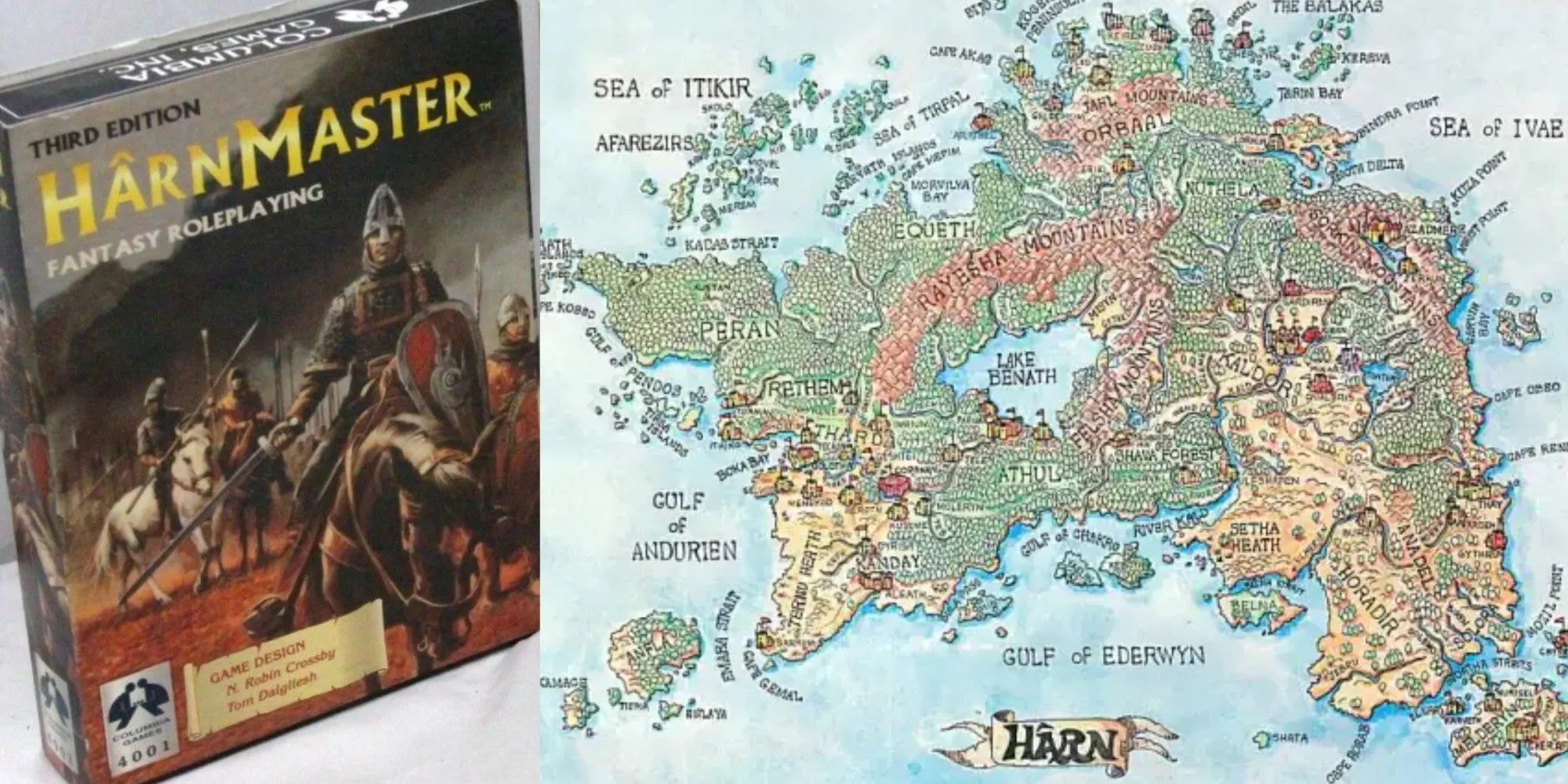
1HârnMaster (1986)
N. Robin Crossby is the storyteller behind the extensive lore of Hârn, the very sophisticated and detailed setting forHârnMaster. This is a great example of world-building for players that are interested in that part of the TTRPG experience, and the backstory of this place is immense.
The original from 1986 is out of print and possibly a collector’s item in case it pops up at a local garage sale. The most recent version, the third edition, was released in 2002 and is much easier to find.