It’s been almost a decade sinceDragon Age: Inquisitionwas released, and fans have been desperate for more information on the next installment in the fantasy series. And Bioware was only too happy to oblige.Dragon Age: Dreadwolfis the official title of the next game in the franchise, suggesting thatit will follow up on the loose threads left hangingat the end ofDragon Age: Inquisition.
RELATED:Dragon Age 4 Companion Wishlist
But what the title doesn’t tell players is how the new game will feel to play. Each game in the series has had its own unique elements, for better or worse, andDreadwolfis likely to be no different. While there are sure to be new mechanics and enhancements in the game, there are a few features from previous titles thatDreadwolfshould absolutely keep.
10The Tactical Camera
Dragon Age IIis often considered an odd duck within the Dragon Age community, as it plays very differently from its predecessor and successor.Dragon Age: Inquisition,in many ways, felt like a response to the fan reaction toDragon Age 2, as the third entry shifted back to a more strategic gameplay style. One new featureInquisitionincluded was something called the Tactical Camera.
The Tactical Camera allowed players to pause the action happening live on-screen and reposition their party and queue up actions like special attacks or healing. It gave players an unprecedented level of fine control over each battle and was a groundbreaking mechanic that setInquisitionapart from both previous titles.

9Romancing Allies
It’s a staple at this point for Bioware games to provide players withparty members and allies they can romance, and it would be foolish of Bioware not to include that system inDreadwolf. The built-in dating sim element of all their games is often the most popular mechanic and has driven many of their characters to widespread fame.
One of the most exciting aspects of a new Bioware game is meeting the new companions and figuring out which ones click with a particular play style or personality type. In some cases, the choice of which companion to form an intimate relationship with could even have long-lasting, narrative significance.

8Combo Effects
WhileDragon Age IIis not looked back on very fondly, there was one aspect of that game that was solid enough to stick around forInquisition:combo effects. Combo effects were synergistic status effects that players could inflict on their enemies with the right combination of attacks from various party members.
These combo effects had a wide range of effects from stripping enemy armor to leaving them stunned and unable to attack for a set period of time. They added another level of strategic depth to battles that made the player’s choice of party lineup feel more significant, and they should definitely return forDreadwolf.

7Gear Crafting
One of the more interesting elements ofInquisitionwas how creative (and often necessary) gear crafting was. Players could use recipes found throughout the game to craft different pieces of armor and weapons, but the color and stats of the gear were entirely dependent on what materials players used in the crafting.
RELATED:The Best Weapons Of Dragon Age: Inquisition (And How To Get Them)
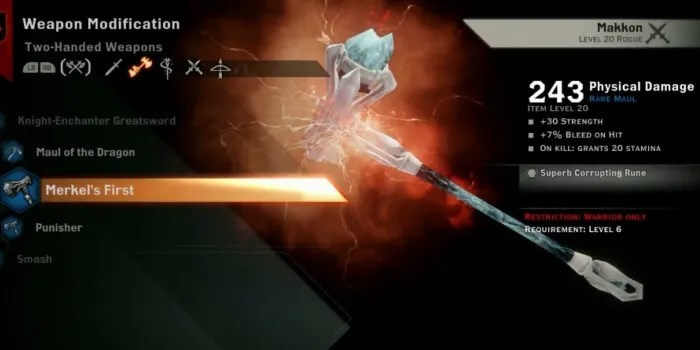
Bioware managed to pull this off by making each recipe require a specific category of material rather than a specific material itself. Higher-level materials produced better quality gear, and players could even give each crafted piece its own name. It would be awesome to seeDreadwolfexpand on this system and also make it easier to organize and keep track of collected crafting materials.
6Customizable Base
Skyhold was the player’s base of operations inInquisition, and over time the new inhabitants repaired the crumbling ruin, restoring it to its former glory as a seat of power and influence. As players progressed through the game and Skyhold became whole again, new customization options were also unlocked for the entire castle, including curtains, banners, and even the throne in the central hall.
It was a nice touch thatallowed each player to feel like they really had ownershipover their own version of Skyhold. Because character interaction is so important in these games, having a personalized hub area where players can talk to their allies and make plans for their next outing was an appreciated inclusion thatDreadwolfshould emulate.

5Branching Narrative
It goes without saying that Bioware and branching narratives are basically synonymous at this point. BothMass EffectandDragon Ageare based on the concept, and they pushed it to an unprecedented level by allowing players to bring those choices and character paths into each subsequent game.
Dreadwolfabsolutely needs to include a branching narrative structure, though Bioware may need to make some definitive decisions onwhat events from past games can be considered canon. That said, where the story goes next is anybody’s guess, but it will certainly shift to reflect the player’s choices along the way.

4Open Environments
Dragon Age: Inquisitionlaunched in 2014 and millions of players dove into the world of Thedas to discover a rich, teeming game filled with a vast array of locales to explore. In fact, many didn’t make it out of the original area, the Hinterlands, for several hours after they’d completed the main objective for that region.
RELATED:Games Every Lover Of High Fantasy Should Play
The reason for this is thatInquisitionwas filled with what was essentially a series of mini,open-world environments filled with quests, rare enemies, and special collectibles. IfDreadwolfdoesn’t go the route of so many other games and feature a totally open world, then it should definitely take a page fromInqusition’s book and make a bunch of smaller, less-daunting environments for players to explore.
3Management Sim
Inquisitionhad a lot of moving parts that easily made it the deepest game in the Dragon Age franchise. One of these was a management sim where players had to choose which of their allied advisors they wanted to oversee certain operations around the world. This, in turn, would grant special rewards or influence that allowed the player to unlock perks for the entire Inquisition.
Choosing which ally to rely on in certain situations and how to balance the time it would take for them to complete their operations was a mini-game unto itself. The different stories that arose and rewards earned for choosing different advisors made each choice feel impactful, andDreadwolfwould benefit from a similar system.

2Multiple Protagonist Races
One of the biggest criticismsDragon Age IIfaced was the fact that players were stuck playing the game as Hawk, a fairly generic human character. While players could still pick their own class and tailor Hawk’s personality based on dialogue options, it still felt like a step backward afterDragon Age: Originshad a variety of protagonist races that each had multiple backstories.
Dragon Age: Inquisitionrighted the ship by bringing backrace selection as an option for players when creating their Inquisitor, and Bioware even added the option to play as a Qunari for the first time.Dreadwolfcan’t repeatDragon Age II’s mistake, or there might not be a fifth installment in the series.

1Leliana
Leliana is one of the most important characters in the entirety of Dragon Age lore, and one of the few that appears in all three games. InDragon Age: Origins, Leliana is both a party member and a potential romance option, inDragon Age IIshe pops up in the “Exiled Prince” DLC, and inDragon Age: Inquisitionshe’s one of the player’s three, main advisors.
Her presence throughout Thedas can’t be overstated, and a Dragon Age game without Leliana just feels wrong. She’s been an ally to each of the game’s protagonists and was even the main, playable character in one of the story expansions forOrigins.She’s also an incredible archer, so having her around is always preferred.

Dragon Age: Origins, Dragon Age 2,andDragon Age: Inquisitionare available on Xbox 360, Xbox One, Xbox Series X|S, PlayStation 3, PlayStation 4, PlayStation 5, and PC.Dragon Age: Dreadwolfdoes not yet have a release date or confirmed platforms.
MORE:Games To Play If You Love Dragon Age

